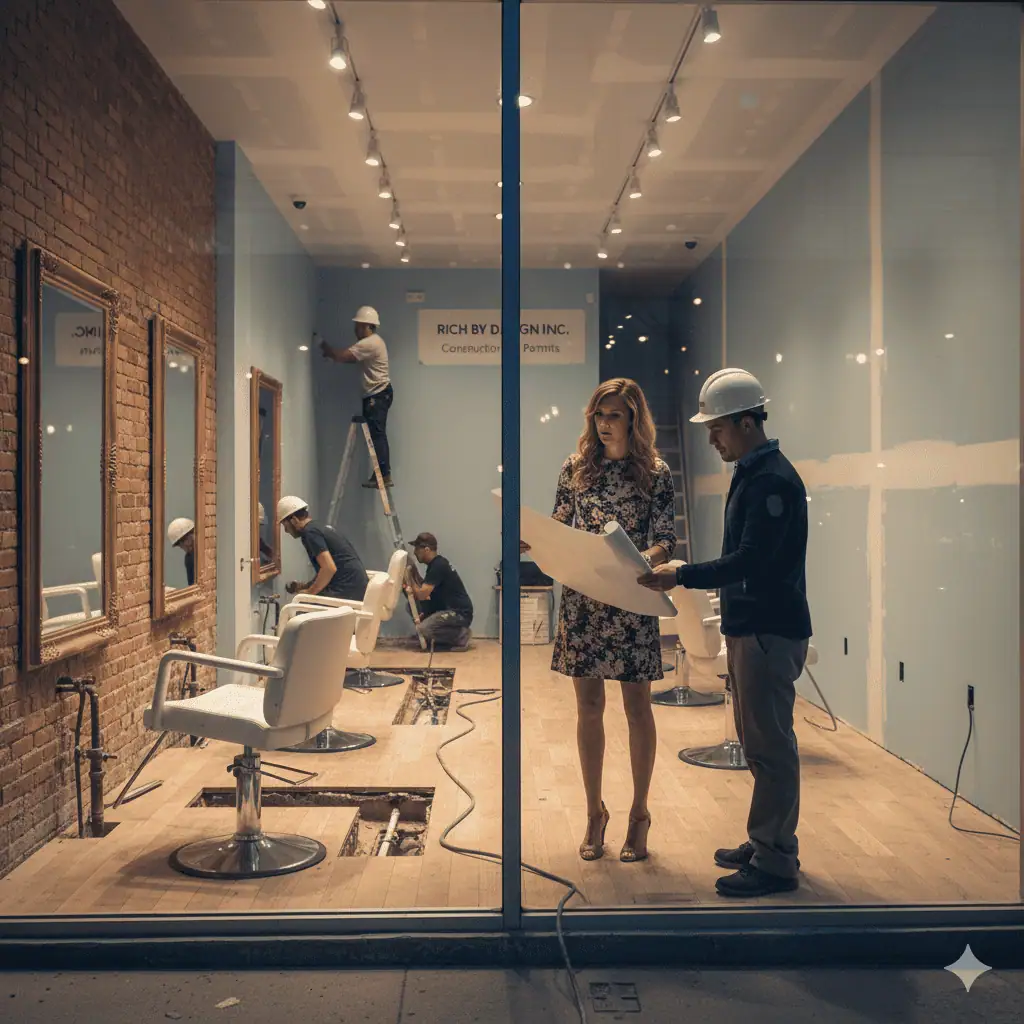
1. Why Retail → Salon Is Not “Just a Cosmetic Renovation”
You’ve found the perfect storefront location. Maybe it’s a former clothing boutique on Queen West, a vacated cell phone shop in a Etobicoke plaza, or a street-level retail unit that’s been sitting empty for months. The bones look good, the rent is right, and you can already picture your salon chairs lined up along the exposed brick wall.
But here’s what catches most first-time salon owners off guard: converting that retail space into a hair or beauty salon isn’t a simple matter of painting walls, installing mirrors, and hanging your business sign. What you’re planning is a Change of Use from Group E (Mercantile) to Group D (Business/Personal Services) under the Ontario Building Code and that designation changes everything.
This isn’t just about aesthetics or interior decorating. We’re talking about construction permits, engineered drawings, plumbing rough-ins, ventilation systems, accessibility upgrades, and multiple rounds of inspections before you can legally open your doors. The former retail tenant could get away with a single washroom and minimal mechanical systems. Your salon? It needs shampoo bowls, proper drainage, chemical exhaust, barrier-free accessibility, and infrastructure that meets today’s building and health codes.
Understanding what a Change of Use permit actually entails and planning for it early is the difference between a smooth launch and a six-month delay with your lease clock ticking. At Rich by Design, we’ve guided dozens of salon owners through this exact process, turning retail shells into thriving hair salon spaces that are both beautiful and fully compliant.
Let’s walk through what you really need to know.
2. Understanding Change of Use: Group E → Group D
2.1 What “Change of Use” Means in Toronto
In Toronto’s regulatory world, a Change of Use isn’t just a new business moving in—it’s a fundamental shift in how the building department evaluates your space. When you apply for a building permit to convert retail into a salon, the City doesn’t simply review your renovation plans. They reassess the entire space against current building code requirements as if it were new construction for that use category.
This matters because building codes evolve. The retail space you’re taking over might have been permitted 15 years ago under older accessibility standards, with grandfathered mechanical systems and a washroom that barely met the requirements of its time. The moment you trigger a Change of Use, that grandfathering disappears. Your salon must meet 2024’s Ontario Building Code, AODA accessibility standards, and Toronto-specific requirements for personal services settings.
The result? What looked like a simple interior renovation suddenly requires architectural drawings, mechanical engineering, plumbing upgrades, and a completely rebuilt washroom. Change of Use permits also mean longer review times, multiple consultant involvement, and coordinating inspections across building, mechanical, plumbing, and health departments.
2.2 Group E (Mercantile) vs Group D (Business/Personal Services)
The Ontario Building Code classifies buildings by occupancy groups, and each group comes with different safety, accessibility, and servicing requirements:
Group E (Mercantile) covers retail sales operations clothing stores, phone shops, gift boutiques. These spaces focus on displaying merchandise and processing transactions. Code requirements assume moderate occupancy loads, minimal plumbing (often just a staff/customer washroom), standard ventilation, and straightforward exiting.
Group D (Business/Personal Services) includes offices, salons, spas, and personal care settings. The code treats these spaces as higher-intensity occupancies because they involve closer client interaction, chemical use, water services, and more complex functional requirements.
When you move from Group E to Group D for a salon, the reclassification triggers:
- Increased plumbing fixture counts: Multiple shampoo bowls, colour bar sinks, staff hand-washing stations, and upgraded washroom facilities
- Enhanced accessibility requirements: Barrier-free paths to all client service areas, accessible washrooms with proper clearances and grab bars, maneuvering space around styling stations
- Different ventilation and exhaust expectations: Local exhaust for chemical mixing areas, general ventilation for odour control, makeup air to balance exhaust systems
- Life safety re-evaluation: Exit paths, occupant loads, fire separation, and emergency lighting reviewed under the new use
The City doesn’t make these distinctions to create red tape. A salon introduces plumbing risks (backflow, drainage), air quality concerns (chemical fumes), and accessibility needs (close-contact services) that a simple retail store never required.
2.3 When a Hair Salon Definitely Triggers Change of Use
If you’re wondering whether your salon project needs a full Change of Use permit, here are the scenarios that almost always require one:
- First salon use in a previously pure retail unit – You’re introducing new occupancy characteristics the space was never designed for
- Adding hair-washing stations, shampoo bowls, or colour bar sinks – Any new plumbing fixtures beyond what existed trigger permit review
- Installing esthetics rooms, treatment rooms, or private service areas – Partitioned spaces change occupancy loads and exiting requirements
- Significant interior reconfiguration – Moving walls, changing circulation patterns, or altering the entry sequence
- Major mechanical or plumbing work – New HVAC systems, exhaust hoods, or rough-in plumbing for multiple service stations
Even if the previous tenant was also a salon, you may still need permits if you’re reconfiguring the layout, adding stations, or upgrading systems. Don’t assume that “it was already a salon” means you can skip approvals.
For a comprehensive breakdown of Change of Use requirements, timelines, and strategies, read our full Change of Use guide.
3. Approvals and Drawings You Need Before Construction
3.1 Zoning & Licence Checks for Personal Services
Before you sign a lease or submit building permit drawings, verify two critical things:
Zoning compliance: Confirm that the property’s zoning designation permits personal services uses. Most commercial and mixed-use zones in Toronto allow salons, but some areas have restrictions—especially in heritage districts or residential conversion zones. Your commercial real estate agent should confirm this, but independently verify with the City’s zoning bylaw.
Business licence category: Toronto requires a specific business licence for personal services settings, which includes hair salons, barbershops, spas, and esthetics clinics. This isn’t the same as your building permit—it’s a separate operating licence issued by Municipal Licensing & Standards.
Additionally, Toronto Public Health classifies salons as “personal services settings” subject to infection control and sanitation regulations. You must notify Public Health before opening or substantially renovating your salon. They’ll want to know about your layout, equipment, and operational procedures before they approve your space for business.
3.2 Building Permit vs Business Licence vs Health Inspection
Let’s clarify the three distinct approval streams you’ll navigate:
Building Permit (Toronto Building)
Covers all construction, plumbing, mechanical, and electrical work. This is where your Change of Use application lives. Building reviews your drawings for code compliance, issues permits, and conducts inspections at rough-in and final stages. You cannot legally start construction without this permit, and you cannot occupy the space without final approval.
Business Licence (Municipal Licensing & Standards)
Required to operate a salon or personal services business in Toronto. You’ll need proof of space occupancy (final building inspection approval) before this licence is issued. The business licence also requires that licensed practitioners (hairstylists, estheticians) meet provincial certification requirements.
Public Health Inspection (Toronto Public Health)
Focuses on sanitation, infection prevention, and safe operational practices. Public Health inspectors will review your hand-washing facilities, disinfection protocols, sharps disposal (if offering esthetics), and general cleanliness standards. They’ll visit before you open and conduct periodic re-inspections.
All three approvals must align. You can’t open your salon with just a business licence you need building final approval and health clearance. Coordinate these timelines carefully.
3.3 Required Drawings and Consultants
A retail-to-salon conversion requires professional architectural and engineering drawings stamped by qualified practitioners. Here’s what you’ll typically need:
Architectural Drawings (prepared by an architect or registered designer):
- Code-compliant floor plan showing all partitions, doors, barrier-free routes, and fixture layouts
- Reflected ceiling plan indicating lighting, sprinklers, and ceiling-mounted equipment
- Elevations and sections for millwork, cabinetry, and built-in elements
- Accessibility compliance drawings demonstrating AODA conformance
Plumbing Drawings (prepared by a licensed plumber or engineer):
- Drainage and vent layout for all shampoo bowls, sinks, and washroom fixtures
- Water supply routing and backflow prevention devices
- Location of cleanouts, floor drains, and specialty traps
Mechanical/HVAC Drawings (prepared by a mechanical engineer):
- Ventilation and exhaust system design, including local exhaust for colour bars
- Heating and cooling load calculations
- Makeup air and fresh air requirements
- Equipment schedules and specifications
Electrical Drawings (prepared by a licensed electrician or engineer):
- Power distribution for styling stations, dryers, equipment, and back-of-house
- Lighting layout with dimming controls and task lighting
- Emergency lighting and exit signage
- Panel schedules showing capacity and loads
The City won’t accept hand-sketched plans or DIY drawings. You need professional-grade construction documents sealed by practitioners who carry errors and omissions insurance.
This is where Rich by Design takes over the heavy lifting for you. We coordinate architects, engineers, and code consultants, manage the permit application process, and ensure your drawings satisfy both building officials and your salon’s operational needs. Learn more about our salon construction and outfitting services.
4. The Big Three for Salon Conversions
4.1 Plumbing: Sinks, Backflow, and Drainage
Plumbing is where most retail-to-salon conversions get expensive—and it’s almost always more complex than owners anticipate. A typical retail store might have a single washroom and a janitor’s sink. Your salon? You’ll need:
- Multiple shampoo bowls: Each requires hot/cold water supply, drainage, venting, and often specialized plumbing rough-ins to accommodate tilting bowls
- Colour bar sinks: Deep basins with spray attachments for mixing colour, rinsing tools, and washing out bowls
- Hand-washing sinks: Code-required hand hygiene stations near or at service areas (Public Health loves these)
- Upgraded washrooms: Barrier-free accessible washroom with proper clearances, grab bars, and fixture heights
- Mop sink and service sink: For cleaning, chemical disposal, and back-of-house maintenance
Here’s what makes this complicated:
Backflow prevention: Shampoo bowls and service sinks present backflow risks—contaminated water siphoning back into the building’s potable water supply. Most jurisdictions require backflow preventers (RPZ valves or similar devices) on these fixtures, which add cost and require professional installation and annual testing.
Drainage and venting: Every new sink needs proper drainage slope and venting to prevent slow drains and sewer gas infiltration. In older buildings, this often means opening walls and floors to route new drain lines back to existing stacks—or installing new stacks entirely.
Hair and sediment traps: Some municipalities require hair interceptors or sediment traps on shampoo bowl drains to prevent clogs in the building’s main drain line. Confirm local requirements early.
Existing infrastructure limitations: The building’s water pressure, drain capacity, and hot water supply might be marginal for a salon’s simultaneous use of multiple fixtures. Upgrading the water heater, installing booster pumps, or upsizing supply lines may be necessary.
Opening walls and floors to add drains and rough-in plumbing is often the single biggest hidden cost in a retail-to-salon conversion. Budget accordingly and expect surprises once demolition begins especially in older buildings where plumbing layouts are poorly documented.
4.2 HVAC & Ventilation: Fumes, Comfort, and Electrical Load
Walk into any busy salon and you’ll immediately notice the smells—hair colour, bleach, perm solutions, nail polish remover if esthetics are offered. A retail store’s basic HVAC system was never designed to handle chemical fumes, high moisture loads, or the heat generated by multiple hair dryers running simultaneously.
Your salon’s mechanical system must address:
Local exhaust at colour mixing areas: Code and common sense both require exhaust hoods or ventilation directly above colour bars and chemical mixing stations. This isn’t optional—both for indoor air quality and to meet Toronto Public Health requirements for personal services settings.
General ventilation and makeup air: Increasing exhaust means you must also increase fresh air supply (makeup air) to maintain proper building pressure and prevent backdrafting. A mechanical engineer calculates these loads and sizes equipment appropriately.
Odour control and air changes: Salons benefit from higher air change rates than retail spaces—typically 6-8 air changes per hour minimum. This keeps the environment fresh for clients and staff.
Heat load from equipment: Hair dryers, flat irons, curling tools, and high-output lighting generate significant heat. Add a dozen clients and staff, and your cooling load spikes well beyond what the existing HVAC system was designed for.
Electrical system capacity: All this equipment requires power. Multiple styling stations, each with outlets for dryers and tools, plus back-of-house laundry, water heaters, and mechanical equipment it’s not uncommon for a salon conversion to require electrical panel upgrades or new service feeds.
A qualified mechanical engineer should visit the space, review existing systems, calculate new loads, and design ductwork, exhaust, and HVAC equipment. Skipping this step leads to uncomfortable working conditions, code violations flagged during inspection, and costly retroactive fixes.
4.3 AODA & Accessibility: Why the Old Retail Bathroom Is Too Small
Here’s the conversation we have with almost every salon client: “The existing washroom looks fine can’t we just refresh it?” – No! Almost never.
Once your space is reclassified as a Group D personal services setting, accessibility standards apply rigorously. The Ontario Building Code and AODA (Accessibility for Ontarians with Disabilities Act) require:
Barrier-free path of travel: From the entrance through reception, waiting area, styling stations, shampoo area, and washroom—all must be navigable by wheelchair users without steps, narrow doorways, or obstructions.
Door widths and clearances: Minimum 32″ clear width at doors (typically 36″ door), with adequate maneuvering clearance on both sides.
Turning radii and floor space: 60″ diameter turning circles in washrooms and at key service points. Clear floor space beside fixtures for wheelchair transfers.
Washroom fixture compliance: Accessible toilet with grab bars, proper height and clearance. Accessible sink with knee clearance underneath, lever-style faucets, and accessible mirror height.
Styling station accessibility: While not every chair needs to be barrier-free, at least one styling station should accommodate wheelchair users with proper approach clearances and height-adjustable equipment.
The existing retail washroom was likely built to older standards—undersized, with a door too narrow, insufficient turning radius, and fixtures that don’t meet current height or clearance requirements. You’ll almost certainly need to completely gut and rebuild it, often expanding into adjacent space to achieve proper dimensions.
Don’t forget about the storefront entrance: if there’s a step up from the sidewalk, you’ll need a ramp or level threshold meeting slope and landing requirements. This might require coordination with the landlord, building owner, or even the City if you’re altering the public right-of-way.
Accessibility isn’t an afterthought or a nice-to-have. It’s code-mandated, inspected rigorously, and essential for serving all clients equitably.
5. Layout Rules That Actually Affect Design
5.1 Planning the Customer Journey
Great salon design isn’t just about aesthetics—it’s about creating an intuitive, accessible flow from the moment clients walk in until they leave. Your layout must balance operational efficiency, client comfort, code compliance, and staff workflow.
Reception and waiting area: Position the reception desk within clear sightlines of the entrance, with enough circulation space that arriving clients don’t bottleneck. The barrier-free path must extend from the entrance to reception seating without narrow squeezes or obstacles. Consider how clients with mobility devices, strollers, or shopping bags will navigate this zone.
Visual privacy vs. supervision: Clients appreciate some privacy during services, but staff need visual oversight of the entire salon floor. Avoid tall partitions or isolated pockets that create blind spots. Shampoo areas, in particular, benefit from openness both for supervision and because they’re high-moisture zones that need good air circulation.
Circulation width: Aisles between styling stations should be at least 42″ wide to allow wheelchair passage and comfortable movement when chairs are occupied. This also makes the salon feel more spacious and prevents the cramped, narrow feeling common in poorly planned conversions.
Retail display integration: Many salons generate significant revenue from retail product sales. Integrate display shelving near reception or along circulation paths where clients naturally pause but don’t obstruct barrier-free routes or create tripping hazards.
5.2 Functional Zoning Inside the Salon
Think of your salon as a series of interconnected zones, each with specific infrastructure and operational needs:
Reception/Retail Zone
First impression space with check-in desk, retail product display, and waiting seating. Requires good lighting, comfortable temperature control, and welcoming aesthetics. Minimize equipment noise and visual clutter from back-of-house areas.
Styling Stations
The heart of your salon. Each station needs power outlets (minimum two duplex outlets), task lighting, mirror, and adequate spacing from neighboring stations. Plan for 4-5 feet per station width, with proper aisle clearances. Group stations to share plumbing walls if possible this reduces rough-in costs.
Shampoo Area
Requires concentrated plumbing (hot/cold water, drainage) and typically benefits from proximity to an existing plumbing stack to minimize piping runs. Specify slip-resistant flooring—this area gets wet. Good lighting and comfortable reclining chairs are non-negotiable for client experience. Consider acoustics; conversations here should feel semi-private.
Colour Bar and Mixing Area
Needs deep sinks, counter workspace, storage for colour products and tools, and local exhaust ventilation. Locate this near the styling floor for efficiency but slightly separated to contain odours. Excellent task lighting is essential for accurate colour mixing. Plan for locked storage if you’re keeping large quantities of professional-grade chemicals.
Back-of-House/Storage/Staff Area
Every salon needs a staff break area, storage for supplies and equipment, and often laundry facilities for towels and capes. This zone also houses mechanical equipment, electrical panels, water heaters, and service sinks. While clients never see it, proper planning here makes daily operations smoother and keeps retail areas uncluttered.
Tying each zone back to infrastructure: locate your shampoo area near existing plumbing stacks. Position the colour bar where exhaust ductwork can efficiently connect to exterior walls. Place the staff area adjacent to back-of-house utilities. These decisions made early in design prevent costly rerouting during construction.
5.3 Fire Separation, Exiting, and Adjacent Units
Even though your salon might feel like a single open space, code requirements around fire separation and exiting still apply especially in multi-tenant buildings.
Fire separation from adjacent units: Most commercial buildings require fire-rated demising walls between tenants, typically 1-hour fire-rated construction. If you’re adding treatment rooms or partitions, confirm they don’t compromise existing fire separations or create new code violations.
Exit paths and travel distances: The Building Code limits how far occupants can travel to reach an exit. In a single-tenant ground-floor salon, this is rarely an issue. But if you’re subdividing space into treatment rooms or creating a long, narrow layout, consult the Code’s maximum travel distance tables.
Corridor and exit widths: Any corridor leading to an exit must maintain minimum width (typically 1100mm or 44″). If your layout requires a rear exit or emergency egress, ensure doors are unobstructed, properly marked, and meet panic hardware requirements if applicable.
Occupant load calculations: The Building Code assigns occupant loads based on use and floor area. Salons are calculated at roughly 1 person per 4.6 square meters for personal services areas. Higher occupant loads trigger additional exit requirements and larger washroom fixture counts. Your architect or designer will calculate this and show compliance on permit drawings.
If you’re in a plaza or multi-unit building, coordinate with the landlord and neighbouring tenants—especially if your exhaust ductwork, electrical upgrades, or plumbing work affects shared building systems or runs through adjacent lease spaces.
6. Inspections to Expect on a Retail → Salon Conversion
6.1 Building Department Inspections
Toronto Building conducts inspections at key construction milestones to verify code compliance before allowing work to proceed. Expect the following sequence:
Rough-in plumbing inspection: After new drain lines, vents, and water supply piping are installed but before walls close up, a plumbing inspector verifies proper slope, venting, materials, and backflow prevention. This inspection must pass before covering any plumbing.
Rough-in mechanical inspection: Once HVAC ductwork, exhaust systems, and equipment are in place but before ceiling finishes, a mechanical inspector checks duct sizing, clearances, supports, and terminations. They’ll also verify that makeup air and exhaust systems are properly balanced.
Rough-in electrical inspection: After all wiring, panels, and boxes are installed but before drywall, an electrical inspector confirms wire sizing, grounding, panel capacity, outlet locations, and emergency lighting. They’re particularly attentive to high-load equipment like water heaters and HVAC.
Framing and insulation inspection (if applicable): If you’ve built new partitions or altered fire separations, an inspector verifies framing dimensions, fire-rated assembly construction, and insulation installation.
Final building inspection: Once all finishes are complete and the space is ready for occupancy, a final inspector conducts a comprehensive walkthrough. They’ll verify that all previous inspection deficiencies are corrected, accessibility features are properly installed, exits are clear and marked, and the space matches approved drawings.
Only after the final building inspection passes will Toronto Building issue occupancy approval—the document you need before applying for your business licence.
6.2 Public Health & Personal Services Settings Inspections
Toronto Public Health treats salons as “personal services settings” subject to infection prevention and control standards. Their inspection focuses on operational readiness and sanitation infrastructure:
Hand-washing facilities: Public Health wants to see dedicated hand-washing sinks accessible to service providers—ideally at or very near styling stations. These must be separate from shampoo bowls and service sinks used for equipment cleaning.
Disinfection and sterilization: You’ll need systems for cleaning and disinfecting combs, brushes, scissors, and any reusable tools. Public Health will ask about your protocols, cleaning agents, and storage for clean vs. soiled implements.
Waste handling: Proper receptacles for general waste, sharps disposal if offering services like threading or waxing, and sanitary handling of hair clippings and chemical containers.
Overall cleanliness and maintenance: Floors, walls, fixtures, and equipment must be cleanable and in good repair. Public Health inspectors note any mold, water damage, or unsanitary conditions.
This inspection typically happens shortly before opening or during your first few weeks of operation. Public Health will also conduct unannounced re-inspections periodically to ensure ongoing compliance. Maintain good records of your cleaning protocols and staff training—inspectors appreciate documentation.
6.3 Business Licence and Final Sign-Offs
Before you can legally operate your salon, you need a municipal business licence issued by Toronto’s Municipal Licensing & Standards. The application requires:
- Proof of occupancy approval from Toronto Building (your final building inspection clearance)
- Confirmation that all service providers hold appropriate professional certifications (hairstylist licences, esthetician credentials where required)
- Business name registration and insurance documentation
- Payment of licence fees
Once your business licence is issued, you’re legally permitted to operate. But remember: this licence must be renewed periodically, and any changes to your business operations, ownership, or premises may trigger new approvals.
Keep all inspection reports, permits, and licence documents organized and accessible. Future renovations, licence renewals, or even business sales will require this paperwork.
7. Timeline, Common Mistakes, and Cost Drivers
Let’s set realistic expectations. A retail-to-salon conversion is not a six-week project. Here’s a typical sequence:
Design and Engineering (3-6 weeks): Architect and engineers prepare permit drawings, coordinate with consultants, and finalize construction documents.
Permit Review and Approval (4-8 weeks): Toronto Building reviews your submission, issues requests for clarification or revisions, and eventually issues permits. Complex projects or busy review periods extend this timeline.
Construction (6-12 weeks): Demolition, rough-in plumbing and mechanical, framing, electrical, inspections at each stage, then finishes, millwork, and equipment installation.
Inspections and Corrections (2-4 weeks): Scheduling final inspections, addressing any deficiencies noted, and obtaining clearances.
Business Licence and Health Inspection (2-4 weeks): Applying for your business licence, coordinating Public Health inspection, and receiving final operating approvals.
Total timeline: 17-34 weeks from initial design to opening day, roughly four to eight months depending on project complexity, permitting delays, and construction challenges.
Common mistakes that extend timelines and budgets:
- Underestimating plumbing costs and assuming existing rough-ins can be reused (they almost never can)
- Skipping mechanical engineering and discovering mid-construction that the HVAC system is inadequate
- Not rebuilding the washroom to barrier-free standards, then failing final inspection
- Ordering custom millwork and equipment before permits are issued, only to discover the layout must change
- Ignoring zoning or health regulations until the City flags them during permit review
- Attempting DIY or unlicensed contractor work to save money, then facing stop-work orders and costly corrections
The big cost drivers in salon conversions:
- New plumbing infrastructure: Expect $30,000-$60,000+ for multiple shampoo bowls, upgraded washrooms, backflow preventers, and rough-in piping especially if you’re opening walls and floors in an older building.
- Mechanical and HVAC upgrades: Properly sized systems with local exhaust, makeup air, and adequate cooling capacity can run $20,000-$50,000 depending on existing conditions.
- Barrier-free washroom reconstruction: Demolishing and rebuilding to accessibility standards, including fixture upgrades, tile work, and grab bar installation: $15,000-$35,000.
- Custom millwork and salon equipment: Styling stations, reception desk, shampoo bowls, colour bar cabinetry, retail displays these are the visible elements clients see, and quality finishes matter. Budget $40,000-$100,000+ depending on finishes and equipment choices.
- Professional fees: Architect, engineers, permit consultants, project management—collectively 10-15% of construction costs, but essential for navigating approvals smoothly.
This isn’t a “paint and flooring” retail refresh. Plan for $150,000-$400,000+ in total project costs depending on space size, existing conditions, and finish quality. And give yourself a healthy contingency 15-20% for unforeseen conditions discovered during demolition.
8. Case Study: Elevate Beauty Lofts
When we designed and built Elevate Beauty Lofts, we faced many of the challenges typical in retail-to-salon conversions and then some. Here’s how we solved them:
Challenge #1: Inadequate existing plumbing
The former retail space had a single washroom and no floor drains anywhere near where shampoo stations needed to be located. We opened floors to route new drainage to an existing stack, installed backflow preventers on all shampoo bowls, and completely rebuilt the washroom to barrier-free standards with proper clearances and grab bars.
Challenge #2: HVAC capacity and ventilation
The existing rooftop unit was undersized for salon heat loads and provided no local exhaust for the colour bar. We worked with a mechanical engineer to design supplemental exhaust hoods, integrate makeup air, and upgrade cooling capacity—ensuring comfortable conditions even during peak service hours.
Challenge #3: Layout efficiency within tight square footage
Maximizing styling stations while maintaining barrier-free circulation required careful space planning. We positioned shampoo bowls along a shared plumbing wall, clustered the colour bar near exterior walls for exhaust routing, and created clear sightlines from reception across the entire salon floor.
Challenge #4: Accessibility compliance throughout
Beyond the washroom, we ensured proper door widths, maneuvering clearances at styling stations, level thresholds at the entrance, and accessible routing through all client service areas. The result: a salon that welcomes all clients comfortably and meets rigorous AODA standards.
The project required full architectural and engineering drawings, Change of Use permitting, multiple inspection phases, and close coordination with Toronto Building and Public Health. But the result is a modern, functional, code-compliant salon that’s thriving in Toronto’s competitive beauty market.
Learn more about our approach to salon construction and outfitting.
9. Start Your Salon Conversion Properly
Converting a retail space into a hair salon is absolutely achievable but only with proper planning, professional design, and a clear understanding of the regulatory landscape. Cutting corners on permits, underestimating plumbing complexity, or skipping accessibility upgrades will cost you far more in delays, failed inspections, and retrofit work than doing it right from the start.
At Rich by Design, we specialize in navigating Toronto’s Change of Use requirements, coordinating architects and engineers, managing permit submissions, and delivering turnkey salon spaces that are both beautiful and fully compliant. We’ve been through this process dozens of times, and we know exactly where projects get stuck and how to keep yours moving forward.
Ready to start your salon conversion?
Book a Change of Use and salon feasibility consultation and let’s discuss your space, timeline, and budget. We’ll give you honest guidance on what’s possible, what it will cost, and how to launch your salon successfully.
Want to dive deeper into Change of Use requirements?
Read our comprehensive Change of Use guide for detailed information on permits, timelines, and strategies for navigating Toronto’s approval process.
Your dream salon is closer than you think, let’s build it properly, together.